
Digital Sovereignty in Europe: Why It Matters Now—and How Aristech Is Leading the Way
What does digital sovereignty actually mean?
Digital sovereignty refers to the ability of companies and organizations to maintain full control over their data, systems, and digital processes.
This issue is becoming increasingly important, particularly in Europe:
Regulatory requirements such as the GDPR, growing dependence on non-European providers, and geopolitical developments make it clear that digital infrastructure has long been a strategic factor.
The Truth About European Tech Alternatives
It is not uncommon to hear:
“We don’t know of any European alternatives.”
Yet this very narrative no longer holds up to reality.
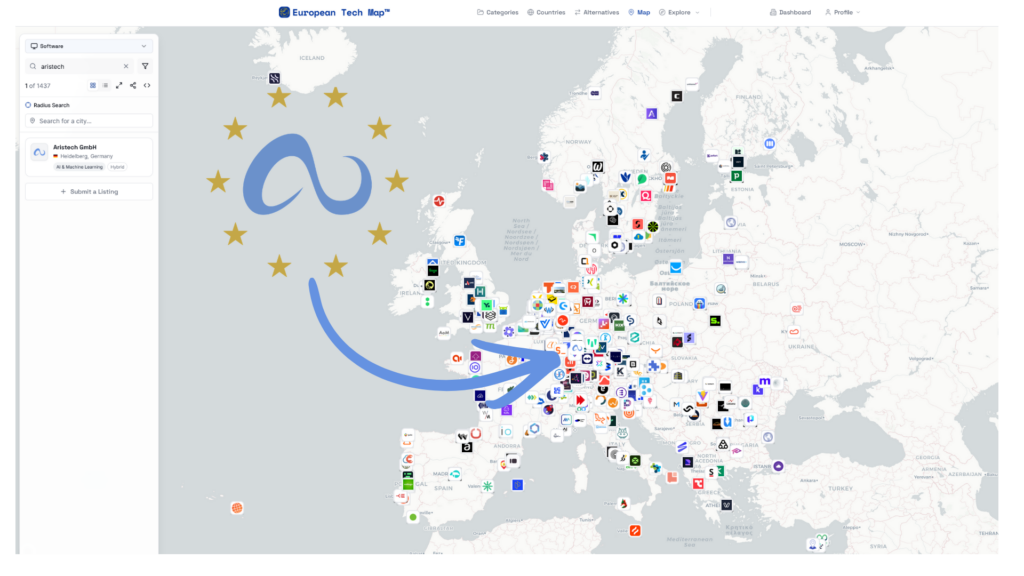
A glance at the European Tech Map shows just how strong the European technology ecosystem has become. Over 1,500 companies from more than 40 countries are represented there – ranging from cloud and AI to cybersecurity and collaboration.
So European alternatives have long been available. And yet, in many companies, they are still too rarely considered. Not because the technology is lacking, but because it is often simply not visible.
This is precisely where one of the greatest challenges for digital sovereignty in Europe lies.
Why digital sovereignty is crucial for businesses
Digital sovereignty is not just a ‘nice-to-have’, but a clear competitive advantage:
Data security & compliance
- Companies must ensure that data is processed and stored in compliance with the GDPR – particularly when it comes to sensitive customer information.
Independence
- Those who rely on external providers quickly lose control over key processes and data.
Secure your future
- Technology decisions determine a company’s ability to act in the long term.
How Aristech puts digital sovereignty into practice
Whilst many are still talking about digital sovereignty, at Aristech we are already putting it into practice.
With our own omnichannel platform, the Aristech AI Suite, for service automation, we take a clear approach:
- Fully developed and controlled technology stack
- GDPR-compliant architecture
- Low-code approach for rapid implementation and scaling
- Focus on automated customer communication and processes
The result:
Companies retain control over their data and processes whilst benefiting from efficient automation.
Service automation as the key to digital sovereignty
Digital sovereignty doesn’t stop at infrastructure – it primarily concerns operational processes.
With modern service automation, companies can:
- Process customer enquiries automatically
- Manage internal workflows efficiently
- Reduce error rates
- Significantly shorten response times
And all this without relinquishing control over data and systems.
Conclusion: Digital sovereignty is a conscious choice
The technologies are already here.
So are the providers.
Now the decision lies with businesses:
Do we stick with the solutions we’re used to, or do we make a conscious choice to opt for European alternatives?
Digital sovereignty has long been a reality. We just need to put it into practice.
See for yourself what this could look like.

