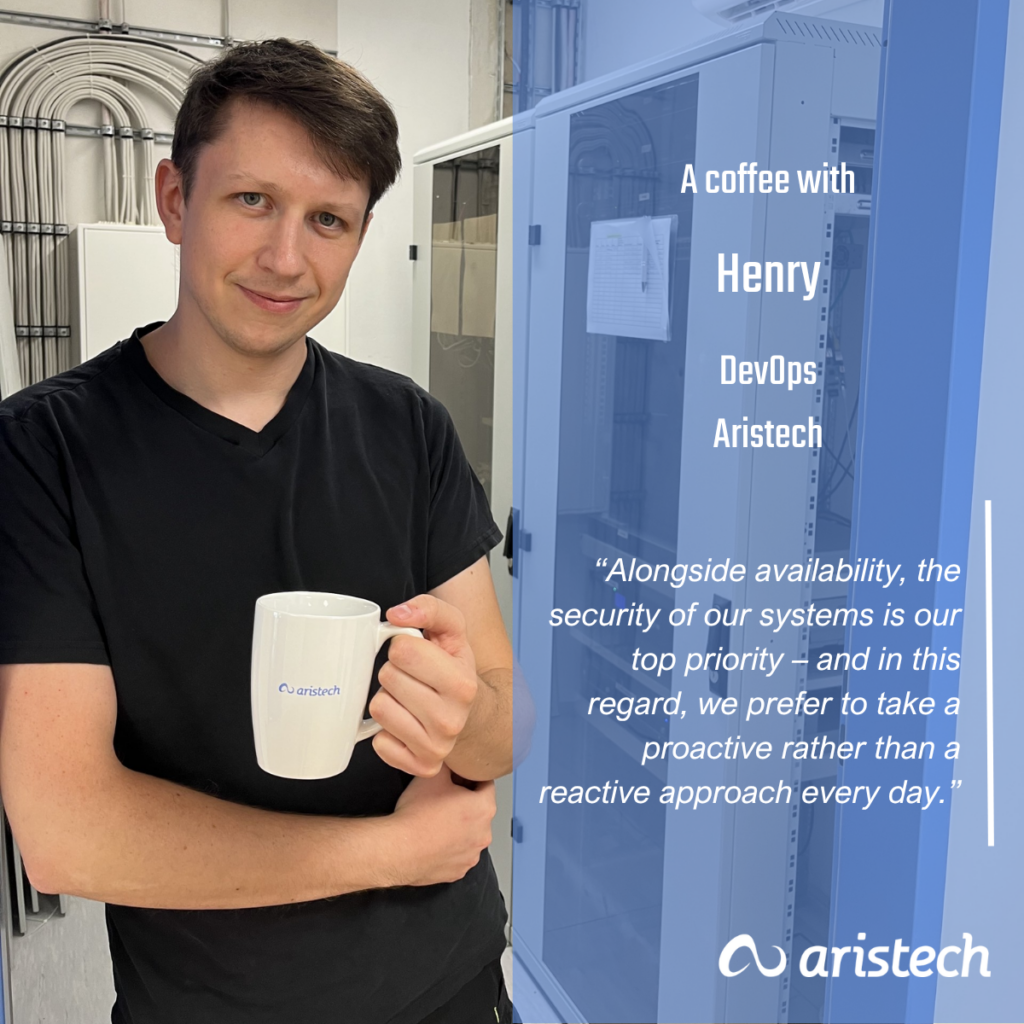
Have a coffee with Henry from the DevOps Team
1. You've been with Aristech since March 2026 – what was your first impression of the team and the work here?
My first impression was positive from the very beginning. Everyone welcomed me very warmly, and in every department I was shown right away how things work, what I need to know and where to find things when I need to look something up. But beyond the technical onboarding, the human side is simply right: Aristech is full of great people who inspire and motivate you.
2. You previously spent several years working in IT operations at other companies – what's different at Aristech compared to what you were used to?
What’s definitely different is our unique and very well-known customer base and the wide range of applications for our product. I was surprised by how versatile our product is and how flexible we are in meeting as many of our customers’ wishes as possible.
3. Put simply: what do you actually do in your job to make sure that, for example, a voicebot or a customer application runs reliably?
In the DevOps team, and I personally as well, we ensure high availability of our components, systems and server landscape using both standardised concepts and ones tailored to our needs. These include, for example, distributed file systems with high redundancy, redundant power supplies or, at a deeper level, cluster systems that keep our applications online at all times. Alongside availability, however, the security of our systems is our top priority – and every day we prefer to act proactively rather than reactively.
4. What has surprised you most since you started at Aristech?
Honestly: how much responsibility and trust you’re given here from day one. Shortly after I started, I was already allowed to take full ownership of my own topics and help shape concepts instead of just watching at first. The technical breadth also surprised me – from storage and networking to our customers’ applications, there really is a bit of everything here. I’m really happy that my expertise and experience were in demand right away and that anyone can come straight to me so we can solve problems and tackle challenges together.
5. How do you approach a new system that has been around for a long time and that you first need to understand?
First, I get an overview: How is the system structured, what dependencies are there, where is the documentation – and where isn’t there any? Then I look at what the system actually does in live operation: logs, monitoring, resource usage – there’s a lot to look at. If I’m unsure, I’d rather test carefully in small steps than make big changes blindly. Plus, my great colleagues are always there to help and have several open ears for every question 🙂
Finally, I document what I’ve found out if anything is still missing from the documentation. This not only ensures that we share knowledge internally, but also gradually removes hurdles for the next team members so they don’t have to start from scratch again.
6. What do you think is the biggest misconception companies have when they believe their technology "just runs by itself"?
The classic: “We set that up once, it’ll be fine.” I’ve reviewed backup concepts myself that looked great at first glance – and then it turns out there are no real restore tests, that there are hidden single points of failure, or that “redundant” isn’t actually completely independent in practice. Technology doesn’t run by itself; it has to be constantly monitored, tested and questioned. Technology evolves very quickly. Falling behind is, I think, the biggest danger in our industry.
7. You've been working in IT operations for many years now – what still fascinates you about this work and has kept you in the field?
What still fascinates me is that you never stop learning in this job – there’s always a new system, a new problem or a new technology to understand. As I mentioned earlier, technology keeps evolving, although some basic concepts rest on deeper principles that are fairly unshakeable. My daily work can sometimes feel a bit like detective work: you follow the clues until you find the real cause of a problem. What motivates me most, though, is the goal that my work in IT operations should be invisible – if nobody notices anything, I’ve done my job right.
8. What nerdy or surprising skill do you have that people wouldn't expect from you?
In my private life, I’m also active in the Chaos Computer Club, and that’s where I got my understanding of “hacking” – which isn’t what most people immediately associate with the word. The CCC even has its own hacker ethics (ccc.de/hackerethik), which at its core is about curiosity, understanding technology and developing it further so that it serves you better – not about harming others or breaking into other people’s systems.
In exactly that spirit, I like to build my own solutions in my spare time when no official ones exist. For example, I’ve built several of my own Home Assistant integrations, including one that automatically stores my backups in iCloud – even though Apple doesn’t offer an official interface for this. People probably wouldn’t expect me to spend my free time reverse-engineering existing technology and making it a little bit better, just so my homelab runs smoothly and automatically.