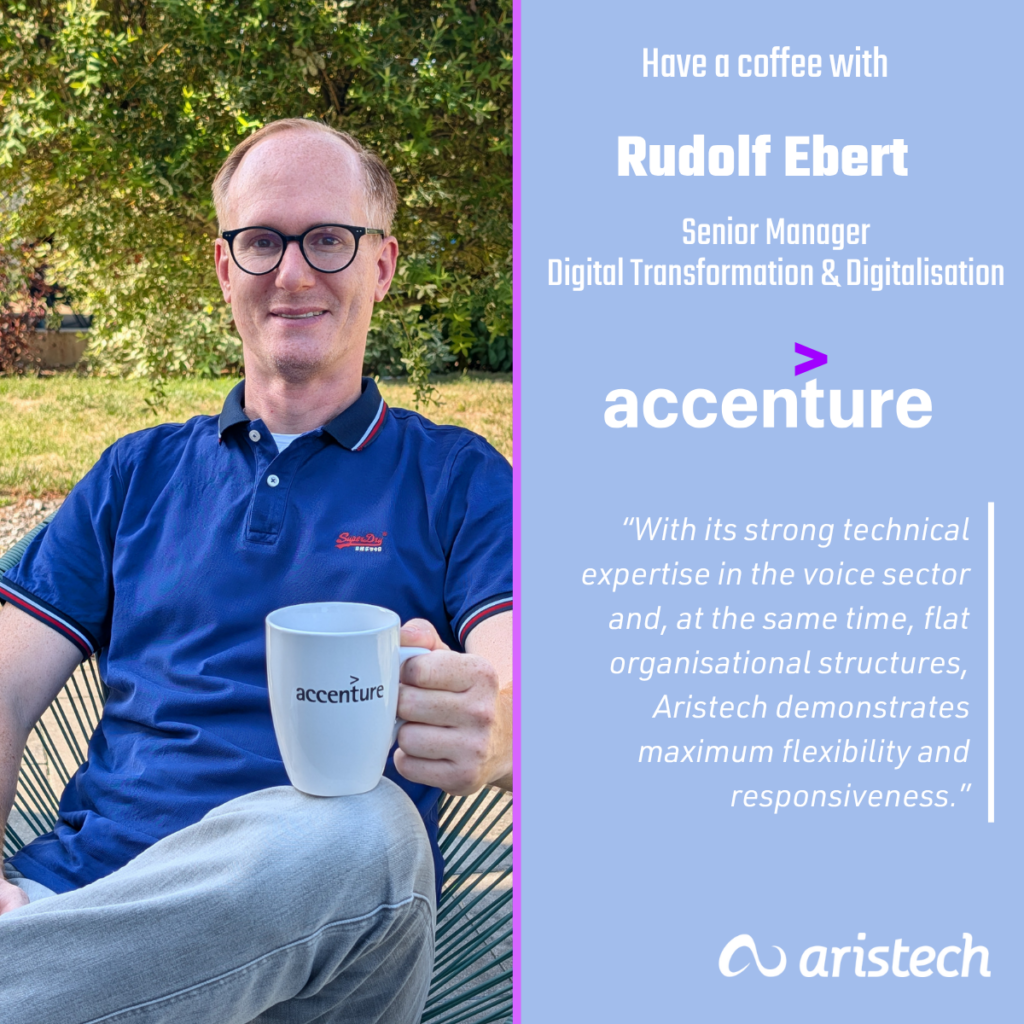
Have a coffee with Rudolf from Accenture
What exactly does Accenture do in our joint voicebot project?
In our latest coffee interview, Rudolf gives an insight into his role, the collaboration with Aristech and what still drives him after 15 years in consulting.
1. Rudolf, you've been working as a Senior Manager in Digital Transformation & Digitalization for 15 years – what has changed the most during that time?
From my perspective, the biggest changes have happened in two areas. The first is collaboration and the process models used to deliver IT projects, which for me include transformation and digitalization projects. Communication and transparency have become increasingly important and are supported by frameworks such as Scrum, Kanban and others.
The other area that has undergone, and is still undergoing, massive change is the technology landscape. Across every sector, you can see that artificial intelligence, cloud technologies and other advances of recent years are having a major impact.
2. At Accenture, you lead our joint voicebot project – how did this collaboration with Aristech come about?
For a public-sector tender, we were looking for an innovative and suitable provider of conversational AI and, specifically, voicebot technologies.
Aristech GmbH stood out as a GDPR-compliant provider of a platform solution covering chat, email and voice requirements. After the first conversations, it quickly became clear that our industry expertise combined with Aristech’s platform would give us a strong competitive edge.
3. What does your day-to-day work as a project lead look like when three parties – Accenture, Aristech and the client – are working together?
In this setup, communication is key: all relevant information has to be exchanged, updated and available quickly and reliably. To avoid creating unnecessary work for the project participants, you also have to weigh up who really needs which information for their part of the implementation. So there’s a lot of coordination with all parties in different constellations. What makes this easier is, on the one hand, the consistently good collaboration with Aristech, who, with their strong technical expertise in voice and their flat organizational structures, show maximum flexibility and responsiveness. On the other hand, the domain knowledge lies with the client, and it is prepared and shared with us by highly motivated experts. This allows us to implement the requirements for the dialogue flows optimally on the Aristech platform. As an experienced consultancy, we bring these worlds together and help achieve the project goals in a focused way by working together as equals.
4. How would you explain in simple terms, to someone with no IT background, what you're building together?
We’re building a system that can handle the requests of the many people who call every day, either partly or fully automatically. This primarily concerns the voice channel, meaning the phone, but in the future also channels such as email. This relieves caseworkers so they can focus more on complex matters that require their expertise. To make this work securely and efficiently, we use Aristech’s sophisticated voice technologies, which on the one hand understand requests in spoken or written form, and on the other can deliver information clearly on the respective channel.
5. The project is set to go live in the autumn – what are you most looking forward to when that moment comes?
The moment when the first figures on successful conversations show up in the production monitoring – that may not sound particularly romantic. But it means that, together with Aristech and the client, we’ve managed to deliver a working, technically demanding solution that makes public administration a bit more functional and digital. And that directly benefits citizens.
6. In your opinion, what is the biggest misconception companies have when they take on digitalization projects?
The big risk is often assuming that having a budget and a strategy means the projects will automatically succeed. But here, too, the devil is in the details. In my experience, strategies have to be thought through end to end and implemented consistently all the way into operation. The planned architecture and technical solution also have to be worked out carefully, because these decisions very often determine what the system can do in its target state. So from the very beginning, you need planning skills and foresight, as well as really good collaboration and coordination between the various disciplines and project participants.
7. After so many years in consulting, what still fascinates you about leading complex projects like this one?
What fascinates me is that no two projects are the same. Changing conditions and goals mean there’s always variety – it never gets boring. And I’ve found that you keep learning, both about technology and about working with people.
For me, that’s what makes projects, and working with technology partners like Aristech, so appealing.
8. Finally, something different: what nerdy or surprising skill do you have that people wouldn't expect at first glance?
Something very down-to-earth and analog: I love to cook, both for guests and for myself. Classic home cooking, but I also like making Asian or Indian dishes.